







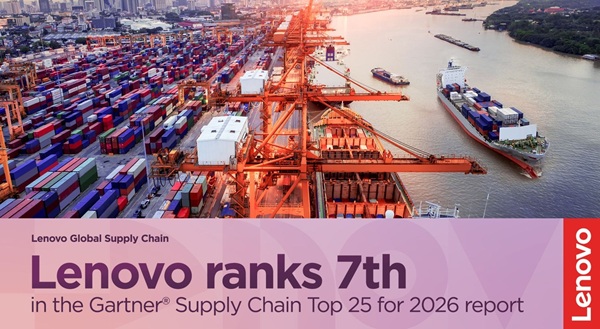
Lenovo has achieved its highest-ever position in the Gartner Supply Chain Top 25, climbing to seventh globally in 2026 as the company continues to strengthen its supply chain through artificial intelligence and automation.
The annual Gartner ranking recognizes organizations with industry-leading supply chain performance based on financial metrics, environmental, social and governance (ESG) indicators, and peer and expert evaluations. Lenovo improved from eighth place in 2025, reflecting continued investments in digital transformation and operational resilience.
Central to Lenovo’s strategy is iChain, an AI-powered orchestration platform that evolved from the company’s Supply Chain Intelligence “digital nervous system.” The platform coordinates thousands of suppliers and more than 30 manufacturing sites worldwide, enabling 60% faster decision-making, near real-time disruption response, and 90% automation of network simulations, reducing analysis time from weeks to just a few hours.
The AI-enabled supply chain has helped Lenovo navigate global challenges, including tariffs, component shortages, and geopolitical uncertainties, while maintaining business continuity and improving operational efficiency.
The technology investments have also supported business growth. Lenovo retained its leading position in the global PC market while expanding its infrastructure business to meet increasing demand for AI servers, enterprise solutions, and next-generation computing workloads. The company is also scaling liquid-cooled server production and strengthening its global manufacturing footprint.
Lenovo’s manufacturing network now spans more than 30 facilities across 10 markets. Recent expansion initiatives include a new manufacturing base in Riyadh, Saudi Arabia, which will produce PCs, smartphones, and servers for the Middle East and Africa, alongside a research and development center. Meanwhile, Lenovo’s facility in Monterrey, Mexico, was recently recognized by the World Economic Forum as part of its Global Lighthouse Network for advanced manufacturing excellence.
The recognition underscores the growing role of AI in modern supply chain management, where intelligent automation, predictive analytics, and real-time orchestration are becoming essential tools for improving resilience and responding to increasingly complex global operations.