




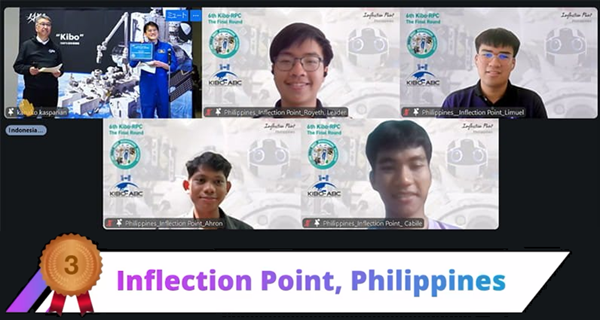
PHILIPPINES EARNS GLOBAL SPACE ROBOTICS HONOR. University of Tokyo Professor Shinichi Nakasuka and JAXA astronaut Norishige Kanai announce the third-place victory of the Philippines’ Team Inflection Point from Batangas State University during the final round of the 6th Kibo Robot Programming Challenge (Kibo-RPC). The achievement marks another international milestone for the Philippines in space robotics and programming after the team successfully competed aboard the International Space Station (ISS). (Photo courtesy of JAXA/NASA.)
The Philippines has secured another international space technology milestone after Team Inflection Point from Batangas State University (BatStateU) placed third in the final round of the 2026 Kibo Robot Programming Challenge (Kibo-RPC).
The team developed a program to command NASA’s Astrobee free-flying robot aboard the Japanese “Kibo” module of the International Space Station (ISS), competing against student teams worldwide in robot navigation, image recognition accuracy, and mission execution speed.
Composed of third-year aerospace engineering students Howell Dela Cruz, John Royeth Samson, Ahron Martinez, Benedict Lontok, Andrew Cabile, and Amer Panganiban, Team Inflection Point continued the Philippines’ strong performance in the competition. The same team earned second place during the country’s Kibo-RPC debut in 2024, becoming the first Philippine team to qualify and win in the international contest.
This year’s competition attracted 738 teams from 37 countries and regions, including participants from 25 countries under the United Nations Office for Outer Space Affairs (UNOOSA). Team Inflection Point emerged as the top Philippine entry during the preliminary round, earning the right to represent the country in the in-orbit finals.
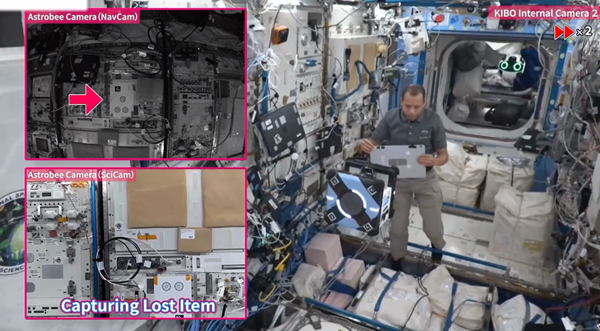
SPACE ROBOTICS IN ACTION. NASA astronaut Christopher Williams monitors Astrobee, NASA’s free-flying robotic assistant, as it navigates the International Space Station (ISS) during the final round of the 6th Kibo Robot Programming Challenge (Kibo-RPC). The robot executes student-developed programs to locate mission objects using its onboard cameras, with inset images showing Astrobee’s live camera views during the in-orbit demonstration. The competition challenges students worldwide to develop autonomous robotic solutions for future space missions. (Screenshot from JAXA’s recording of the 6th Kibo-RPC Final Round in Orbit & Simulation Award.)
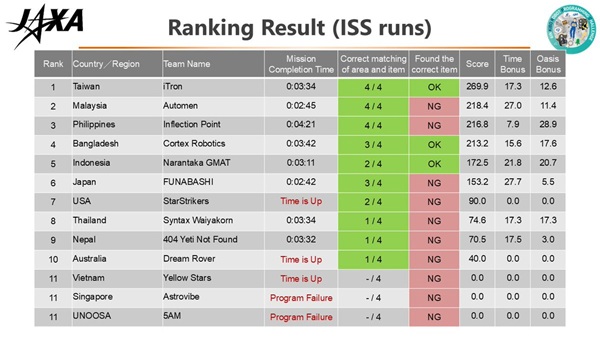
During the live competition aboard the ISS, NASA astronaut Christopher Williams executed each team’s program using the Astrobee robot. The Philippine team successfully completed four of the five assigned tasks, earning 216.8 out of 300 points—just 1.6 points behind second-place finisher Team Automen of Malaysia. Team iTron of Taiwan claimed the championship with 269.9 points.
Organized by the Japan Aerospace Exploration Agency (JAXA) in partnership with NASA, the Kibo Robot Programming Challenge develops the next generation of space robotics engineers by giving students hands-on experience programming autonomous robots designed to support astronauts in microgravity environments.
About the Kibo-ABC Program
The Kibo-ABC (Asian Beneficial Collaboration through Kibo Utilization) program was established by the Space Frontier Working Group (SFWG) of the Asia-Pacific Regional Space Agency Forum (APRSAF) to promote the use of the Japanese Experiment Module “Kibo” aboard the International Space Station (ISS). The initiative aims to expand international collaboration in space research, strengthen the capabilities of participating organizations, and encourage joint projects among Japan and Kibo-ABC member countries.
One of the flagship activities under the program is the Kibo Robot Programming Challenge (Kibo-RPC), which develops students’ skills in space robotics and programming while increasing awareness of the unique challenges of operating in a microgravity environment.
As the Philippines’ lead agency for space science, technology, and applications (SSTA), the Philippine Space Agency (PhilSA) spearheaded the local implementation of the 6th Kibo-RPC. The agency received 27 team applications from across the country between March 12 and May 26, 2025, with seven teams successfully submitting their final programming entries.
The 7th Kibo Robot Programming Challenge is scheduled to open in July 2026, offering another opportunity for Filipino students to showcase their robotics and programming skills on the global stage.
For more information, visit: https://jaxa.krpc.jp.