






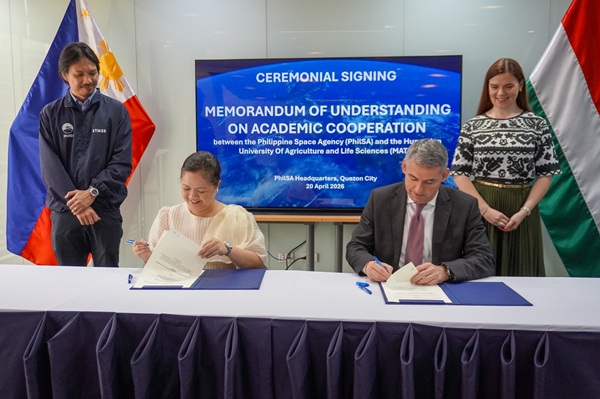
The Philippine Space Agency (PhilSA) has signed a Memorandum of Understanding (MOU) with the Hungarian University of Agriculture and Life Sciences to strengthen the use of space technology in agriculture, marking a significant step in international collaboration on data-driven farming and environmental monitoring.
Formalized on April 20, 2026, the agreement focuses on leveraging satellite data and space science to improve agricultural mapping, monitoring, and assessment. The partnership will enable joint research initiatives, academic exchanges, and the development of advanced models that apply space-based insights to real-world farming challenges.
PhilSA Ad Interim Director General Gay Jane P. Perez emphasized the role of space science in addressing critical issues such as food security and environmental sustainability. She highlighted that collaboration with academic institutions is essential to driving innovation and nurturing future scientists and engineers within the space ecosystem.
Under the agreement, both institutions will facilitate the exchange of students, researchers, and technical expertise, while also promoting knowledge-sharing through publications and training programs. Planned pilot activities in both the Philippines and Hungary will explore practical applications of satellite-enabled agricultural monitoring.
For MATE, Rector Csaba Gyuricza underscored the importance of aligning academic research with societal needs, particularly in supporting farmers and rural communities. The partnership is expected to provide students with access to global expertise and cutting-edge technologies in sustainable agriculture and digital innovation.
The collaboration also reflects broader diplomatic engagement between the Philippines and Hungary, with support from Titanilla Tóth and the Department of Foreign Affairs. It signals a shared commitment to advancing space science and technology applications (SSTA) for sustainable development and climate resilience.
By integrating satellite technology into agricultural systems, the partnership positions both countries at the forefront of precision agriculture—where data, analytics, and space-based tools drive smarter, more sustainable farming practices.