






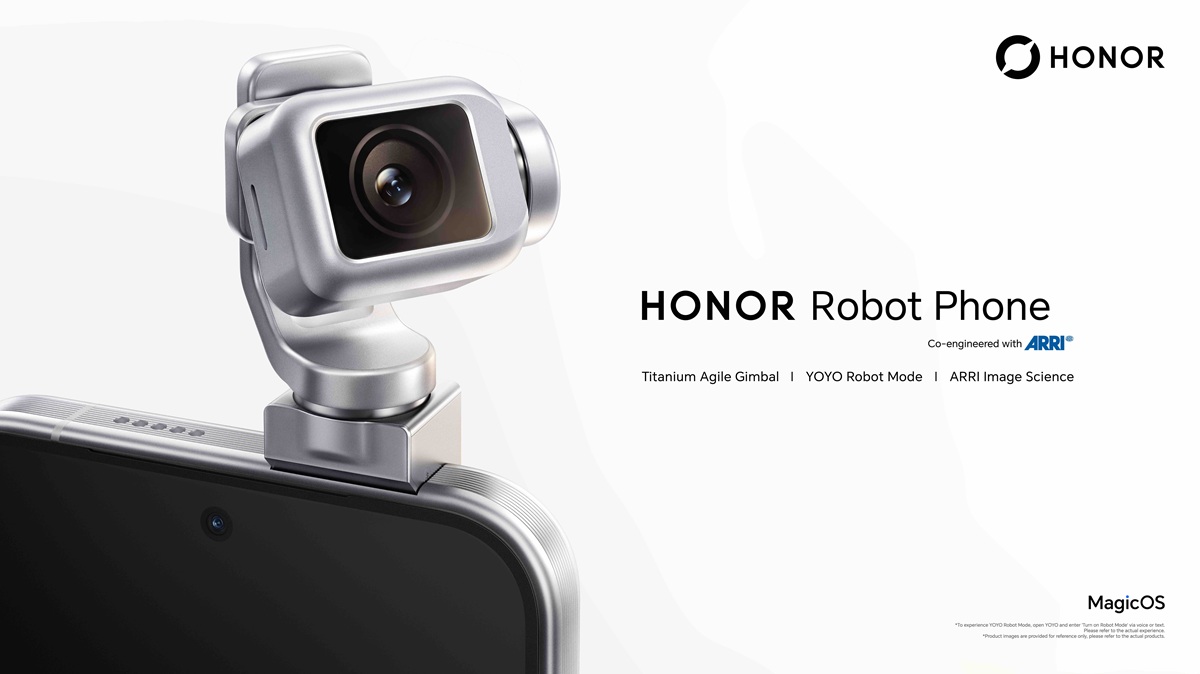
The world’s first robotic smartphone with a fully integrated 4DoF mechanical gimbal, AI-powered motion control, and ARRI Image Science officially launches.
HONOR has officially launched the HONOR Robot Phone, a new smartphone that combines a fully motorized 3-axis mechanical gimbal, AI-powered motion control, and professional imaging technologies in a pocketable device.
The Robot Phone features HONOR’s 4DoF Titanium Agile Gimbal, built from more than 100 precision components through 60 manufacturing processes and backed by more than 100 patents. HONOR said the system is 65% smaller than mainstream gimbals while offering 200% greater structural strength.
At the heart of the system is a 2.6-gram Titanium Gimbal Motor capable of movement speeds of up to 360 degrees per second. A Super Steel Flip Motor provides torque density of 120 N·m/L, allowing the camera mechanism to move and maintain stable positioning.
Cinema technology meets mobile imaging
The Robot Phone is the first product resulting from HONOR’s Cinematic Imaging Partnership with professional cinema camera manufacturer ARRI. The collaboration brings selected elements of ARRI Image Science and professional cinema workflows to a smartphone.
Its camera system is led by a 200MP Agile Gimbal Main Camera with a 1/1.28-inch sensor and f/1.6 aperture, paired with a 200MP periscope telephoto camera with a 1/1.4-inch sensor and 2.7x optical zoom. A 50MP ultrawide camera with a 122-degree field of view completes the rear setup.
The main camera supports 10-bit ARRI LogC3 recording in ARRI CINEMA mode. The system also incorporates ARRI Wide Gamut 3 and ARRI Looks, combined with HONOR’s H1 Image Chip.
HONOR said AI noise reduction can improve video signal-to-noise ratio by up to 8 dB, while AI dynamic range optimization supports up to 14 stops of dynamic range. The imaging pipeline processes RAW data in 14-bit 4:4:4 before producing 10-bit LogC3 and 4:2:2 video for greater flexibility during post-production.
The footage can be transferred to professional editing software such as DaVinci Resolve, where creators can apply ARRI LUTs as part of a mobile capture-to-post-production workflow.
AI turns the phone into a camera crew
The Robot Phone also uses AI to control its physical camera movement. Its camera arm supports modes including Tilt Lock, First Person View (FPV), FPV Vertical, and AI SpinShot.
Running on MagicOS, YOYO Robot Mode combines multimodal perception, contextual understanding, gesture recognition, and physical movement. Voice Source Localization and AI Live-Tracking allow the camera to automatically pan and tilt to keep users in frame during vlogging, livestreaming, and video calls.
Hands-free gestures can also activate the camera arm and trigger shots without touching the device. Meanwhile, YOYO Auto Execution allows the AI agent to understand user intent and perform multi-step tasks across supported apps and system settings.
HONOR is also opening the platform to developers through its Agent Skills interface, allowing third-party developers to build experiences around the phone’s gimbal, perception, and embodied-interaction capabilities.
Flagship hardware
The Robot Phone is powered by the Snapdragon 8 Elite Gen 5 Mobile Platform and features a custom cooling system designed to maintain performance during extended recording sessions.
Power comes from a 7,060mAh silicon-carbon battery, supported by 120W wired and 50W wireless HONOR SuperCharge.
The phone features a 6.31-inch LTPO OLED HONOR AI Eye Comfort Display with a 1–120Hz adaptive refresh rate and peak brightness of up to 6,800 nits. The display is protected by HONOR NanoCrystal Shield and includes 4,320Hz PWM dimming for eye comfort.
HONOR first showcased the Robot Phone at Mobile World Congress 2026 before demonstrating its stabilized tracking capabilities at the Cannes Film Festival’s China Night and the 28th Shanghai International Film Festival.
With its combination of mechanical camera movement, AI-powered interaction, and cinema-oriented imaging, the HONOR Robot Phone represents a shift toward smartphones that can physically interact with their surroundings rather than functioning solely as passive cameras and computing devices.