







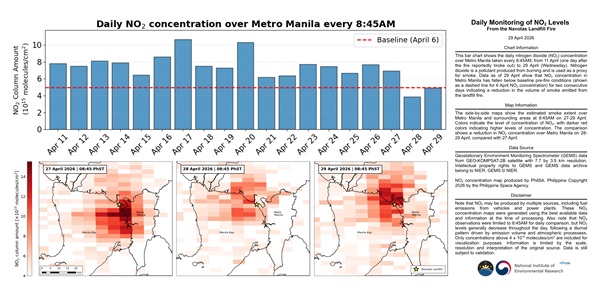
The Philippine Space Agency reported improving air quality over Metro Manila following the suppression of the Navotas landfill fire, based on its ongoing satellite monitoring operations.
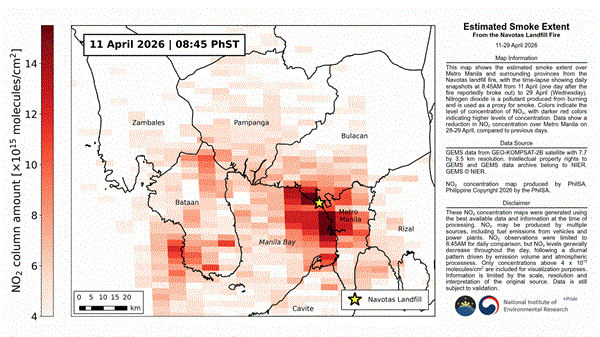
According to PhilSA, nitrogen dioxide (NO₂) levels—an indicator of smoke and combustion—have dropped below pre-fire levels recorded on April 6 for two consecutive days. The improvement coincides with reports on April 28 that fire containment efforts have made significant progress.
Satellite observations revealed a steady reduction in NO₂ concentrations across Metro Manila from April 27 to April 29, supported by ground-level measurements from environmental authorities showing improved particulate matter (PM) levels. NO₂, commonly produced by burning materials as well as vehicle and industrial emissions, serves as a key metric in assessing air pollution during fire incidents.
Using advanced Earth observation tools, PhilSA analyzed data from Sentinel-2C satellites, including near-infrared imaging to map burned areas. As of April 26, the estimated affected area in the Navotas landfill reached 31.95 hectares. While some portions of the site showed a decrease in burned area, others recorded expansion, indicating shifting fire impact zones prior to full containment.
The agency emphasized that satellite readings were taken at consistent intervals (8:45 AM daily) to ensure accurate comparisons, noting that pollution levels typically decrease throughout the day due to atmospheric processes.
PhilSA’s real-time satellite monitoring plays a critical role in disaster response, providing wide-area environmental insights that support the National Disaster Risk Reduction and Management Council and other agencies in decision-making and resource allocation.
As conditions improve, authorities continue to advise the public to follow official health guidance while monitoring continues to assess the long-term environmental impact of the fire.