






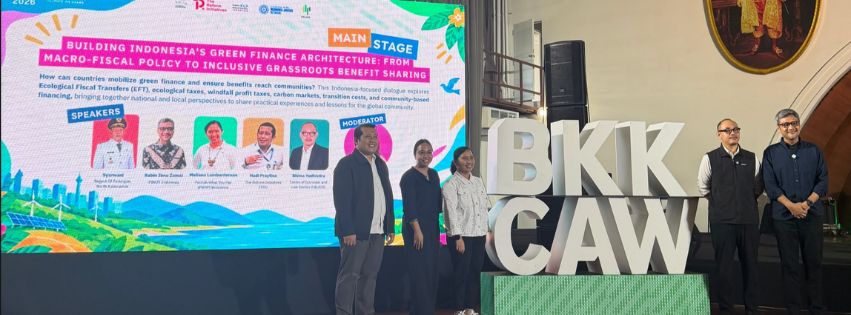
The speakers at the session “Building Indonesia’s Green Finance Architecture: From Macro-Fiscal Policy to Inclusive Grassroots Benefit Sharing” during Bangkok Climate Action Week 2026.
Southeast Asian organisations are exploring research-driven approaches and sustainable innovations to strengthen climate resilience and support economic growth, as discussions at Bangkok Climate Action Week (BKKCAW) 2026 highlighted the potential of a restorative economy.
The model integrates ecosystem restoration into economic development through initiatives such as sustainable agroforestry, watershed regeneration, and nature-based solutions, demonstrating how environmental protection can support local livelihoods and long-term economic value.
Research by Indonesia’s Center of Economic and Law Studies (CELIOS) estimates that restorative economic practices in Indonesia could generate Rp 2,208 trillion in economic output over 25 years while reducing income inequality by 15%.
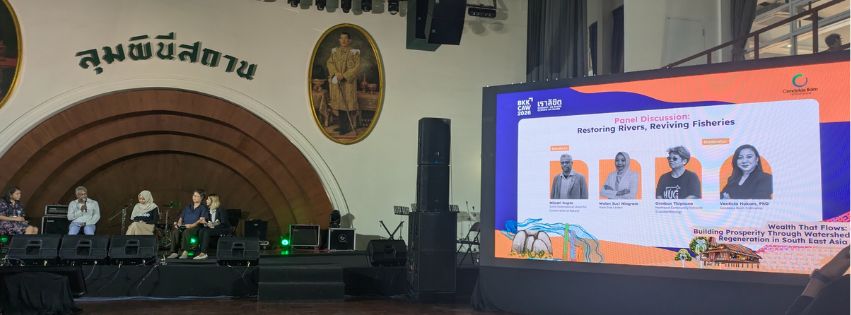
The panelists discuss “Wealth That Flows: Building Prosperity Through Watershed Regeneration in Southeast Asia” during Bangkok Climate Action Week 2026.
The discussions highlighted how research and data-informed policy planning can help guide environmental investments. CELIOS examined mechanisms such as Ecological Fiscal Transfers, environmental taxes, and green finance to direct funding toward ecological priorities and community-led initiatives.
Meanwhile, Cendekia Iklim Indonesia explored how watershed regeneration and agroforestry can help restore natural ecosystems while supporting agricultural production and rural communities. Examples included coffee and macadamia agroforestry in Doi Tung, Thailand.
For the Philippines, these approaches offer potential insights into strengthening climate resilience amid increasing exposure to typhoons, flooding, and other climate-related hazards. Research-led environmental planning and sustainable land management could help communities and decision-makers explore practical responses to these challenges.
The programme also brought together researchers, policymakers, social entrepreneurs, and investors to discuss how restorative economic models could be expanded across Southeast Asia.
As climate risks and sustainability challenges grow, research and innovation can help inform strategies that balance environmental protection with economic development. However, the initiatives presented at BKKCAW 2026 focused primarily on restorative economic models, green finance, and nature-based solutions rather than specific AI systems or digital technologies.