







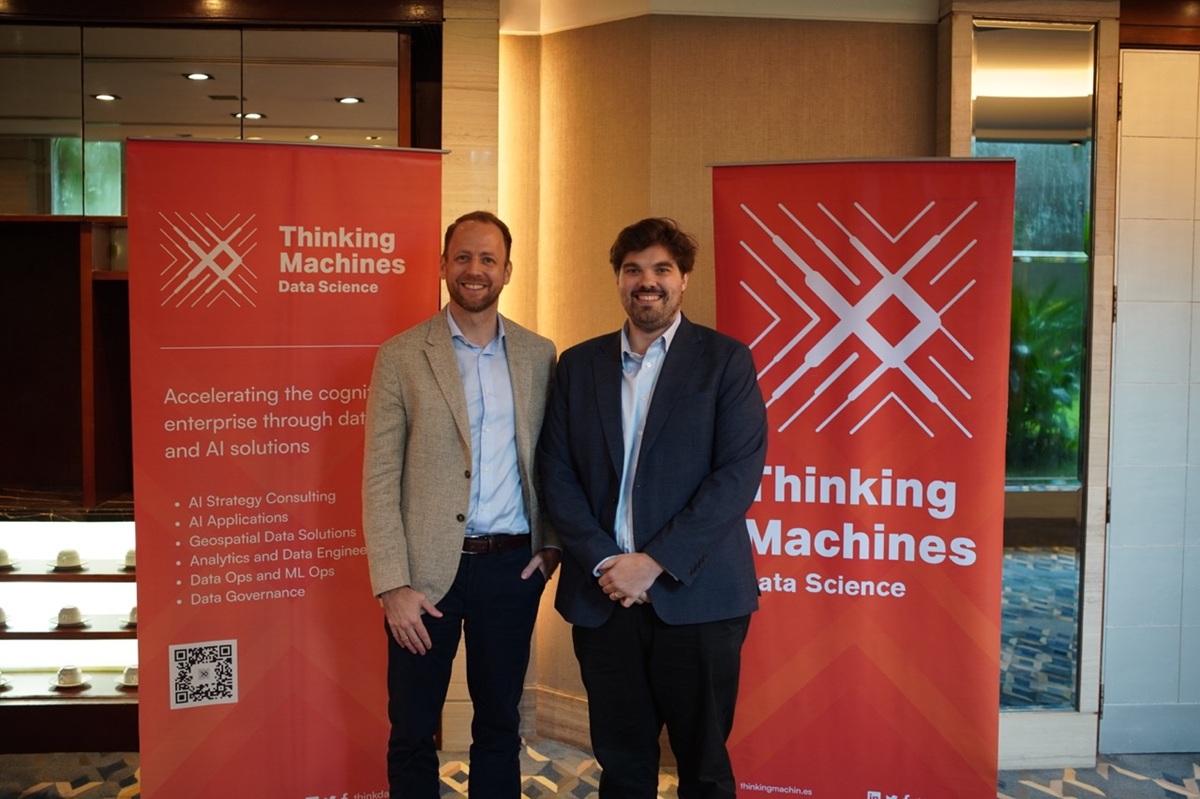
(L-R) Niek van Veen, VP for Commercial, Thinking Machines Data Science, and Mark Jeffrey, Director of Partnerships, Southeast Asia and Taiwan at OpenAI.
Thinking Machines and OpenAI are expanding their collaboration in the Philippines to help businesses and educational institutions move from experimenting with artificial intelligence (AI) to deploying it across real-world workflows.
At a media briefing in Makati City, the companies discussed what Thinking Machines’ recognition as an OpenAI Advanced Partner means for Philippine organizations seeking to scale AI securely and translate its capabilities into measurable business outcomes.
Thinking Machines is one of only 30 companies worldwide recognized as an OpenAI Advanced Partner, a designation reflecting its technical capabilities, delivery experience and ability to provide local expertise.
From AI experimentation to enterprise deployment
As AI adoption grows, organizations are increasingly focused on identifying high-value workflows, integrating AI into existing systems and helping employees adapt to new ways of working.
OpenAI said 40% of ChatGPT messages in the Philippines are work-related, highlighting the opportunity to move from individual AI use toward broader organizational adoption.
For enterprises, Thinking Machines works with teams to identify workflows where AI can deliver value, build AI fluency, redesign processes and deploy solutions within existing data, governance and operational environments.
“AI is easy to experiment with; transforming an organization with it is harder,” said Niek van Veen, Vice President for Commercial at Thinking Machines. “The opportunity now is to turn familiarity with AI into organizational capability — embedding it into the way businesses operate, make decisions, and create value.”
The companies said organizations are increasingly looking beyond individual AI assistance toward agentic workflows that can support decision-making, customer service and team productivity.
Expanding AI access to businesses and schools
The expanded collaboration also includes ChatGPT Business, giving growing teams access to a secure workspace, centralized administration and shared access to ChatGPT.
Thinking Machines plans to support Philippine businesses in applying AI to practical workflows across marketing, sales, finance, operations and management.
The collaboration also covers ChatGPT Edu, designed to help educational institutions deploy AI for students, faculty, researchers and campus operations while maintaining administrative and security controls.
Thinking Machines is supporting schools through workshops, programs and local case studies focused on responsible AI use in teaching, learning, research and operations.
Local expertise seen as key to AI adoption
OpenAI said the Philippines is among its top 15 markets globally for ChatGPT users, reflecting strong local interest in AI and its practical applications.
Mark Jeffrey, Director of Partnerships, Southeast Asia and Taiwan at OpenAI, said the technology could support areas including education, customer experience, workforce skills development and entrepreneurship.
“Our partnership with Thinking Machines brings together OpenAI’s frontier AI capabilities and the local expertise organizations need to put AI to work responsibly and effectively,” Jeffrey said.
For Philippine organizations, the partnership highlights a broader shift in enterprise AI: the challenge is increasingly moving beyond access to advanced models toward implementation, governance, workforce adoption and measurable outcomes.