





Peter Chambers, AMD senior director of OEM Sales for Asia Pacific and Japan and country manager for Australia, leads the company’s regional sales strategy as AMD expands its AI computing portfolio for enterprise and commercial customers.
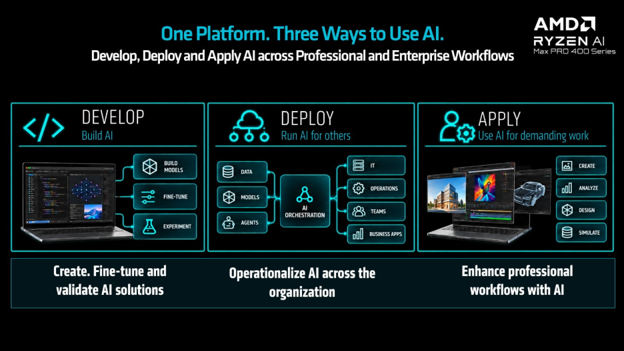
AMD is expanding enterprise artificial intelligence (AI) deployment options with its Ryzen AI Max 400 Series and Ryzen AI Max PRO 400 Series processors, designed to help businesses develop and run AI agents locally while balancing performance, data control, and operating costs.
Unlike generative AI chatbots that primarily respond to prompts, AI agents can execute complex, multi-step tasks across applications, retrieve information, and take actions with varying degrees of autonomy. Running these workloads requires substantial computing power and memory, particularly when agents work with large AI models, enterprise data, and multiple software tools.
AMD’s latest processors feature up to 16 Zen 5 CPU cores, a neural processing unit (NPU rated at up to 55 TOPS), and up to 40 GPU compute units. Their unified memory architecture supports up to 192GB of memory, with as much as 160GB available for GPU workloads.
AMD says the Ryzen AI Max PRO 400 Series is the first x86 client processor capable of running models with more than 300 billion parameters at four-bit quantization without cloud offloading.
The platform supports Windows and Linux environments and works with AI development tools and frameworks such as PyTorch, vLLM, llama.cpp, Ollama, ComfyUI, and LM Studio. These capabilities can support AI model testing, agent development, retrieval-augmented generation (RAG), and local execution.
Local and cloud AI can work together
AMD is promoting a hybrid deployment strategy that combines local computing with cloud-based AI services. Businesses can process suitable workloads locally while relying on cloud models when more advanced capabilities are needed.
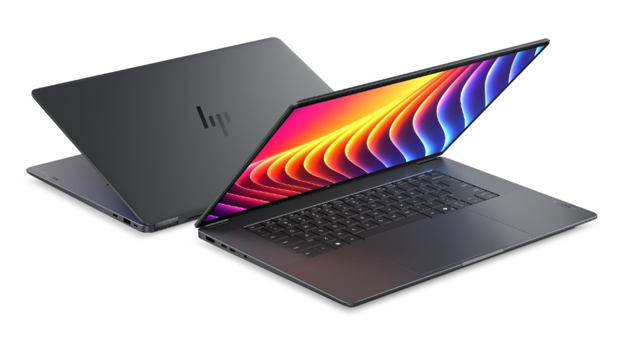
One example is HP’s ZBook Ultra G3a 16, which pairs the AMD Ryzen AI Max+ PRO 495 processor with Perplexity Portable Computer. The system supports local AI models and agents alongside professional applications, with cloud access available for tasks that require it.
Local execution can also help organizations maintain greater control over sensitive business information by reducing the need to send proprietary documents, source code, and engineering files to external AI services.
AMD highlights potential AI cost savings
AI agents may consume significantly more tokens than conventional chatbots because they repeatedly reason, retrieve information, and invoke models while completing tasks. These activities can increase cloud inference expenses.
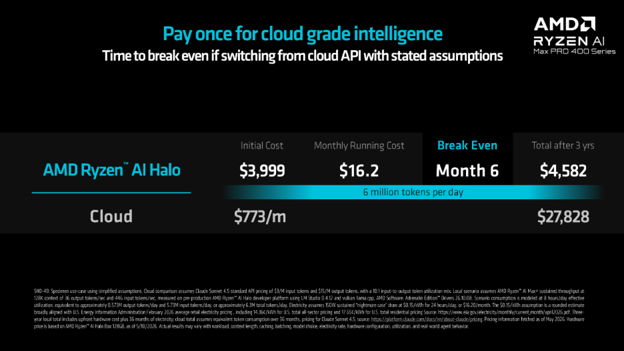
AMD’s Tokenomics Calculator allows organizations to compare estimated costs for cloud-only, local-only, and hybrid AI deployments based on projected usage, hardware requirements, and cloud-model pricing.
However, actual savings depend on workload, hardware costs, utilization, electricity prices, model selection, and cloud pricing. AMD’s comparisons use specific assumptions and should not be treated as guaranteed cost reductions.
With its Ryzen AI Max 400 Series processors, AMD aims to give enterprises more flexibility in deploying AI agents while determining where workloads should run and how sensitive data should be handled.