






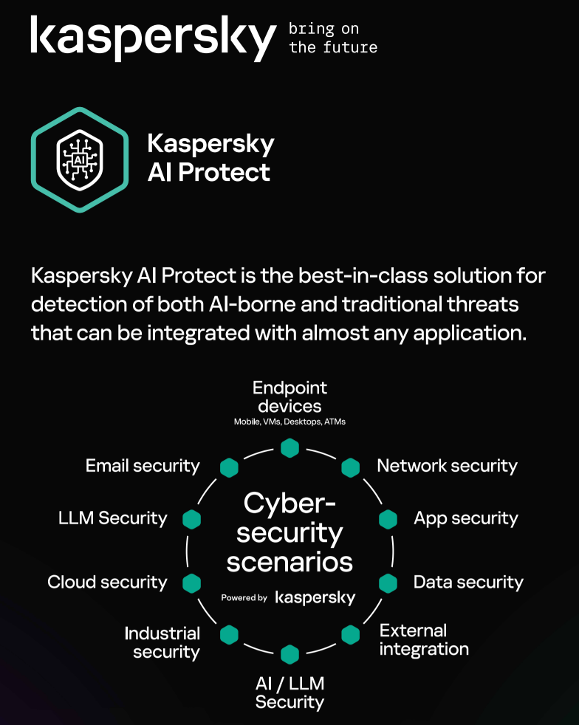
Kaspersky has officially launched Kaspersky AI Protect (KAIP) across the Asia Pacific region, introducing a security solution designed to protect enterprise AI infrastructure from emerging AI-specific threats as well as conventional cyberattacks.
KAIP is designed to detect threats involving Large Language Model (LLM) files and AI agents, including malicious functionality, model poisoning and other risks that can emerge as organizations integrate AI into business systems.
The launch comes as Asia Pacific faces increasing cyber threats while enterprise AI adoption accelerates. Kaspersky said the region accounts for more than 60% of recorded cyberattacks worldwide, with manufacturing and IT services among the most targeted sectors.
Kaspersky also reported that more than 92,000 malicious attacks disguised as AI services were recorded globally during the first half of 2026.
Protecting the AI supply chain
As enterprises deploy on-premises LLM frameworks, Retrieval-Augmented Generation (RAG) knowledge bases and AI-agent platforms, security risks can extend beyond traditional endpoints and network perimeters.
According to Adrian Hia, Managing Director for Asia Pacific at Kaspersky, organizations can face threats through externally sourced model weights, AI plugins and skill scripts, even when their LLMs are hosted internally.
KAIP is designed to address these risks by checking LLM files and AI-agent files for malicious functionality while maintaining protection against traditional cyber threats.
“Security should not act as a barrier to AI advancement, but rather as an enabler that unlocks AI’s scalable value,” Hia said.
The platform is designed to provide protection for web portals and applications, proxy servers, network-attached storage and mail gateways. It can be deployed through HTTP and ICAP as a standalone service, scalable cluster or Docker container.
Designed for enterprise AI environments
KAIP runs on Linux and supports deployment as an individual container or through environments including Docker Swarm, Kubernetes and AWS EKS, as well as similar cloud platforms.
The solution can also be integrated with third-party hardware and software security products through the Kaspersky Technology Alliance ecosystem, allowing technology partners to incorporate its capabilities into their own security offerings.
Simon Tung, General Manager for ASEAN and Asia Emerging Countries (AEC) at Kaspersky, said organizations need greater visibility into AI infrastructure as threats evolve alongside AI adoption.
“At the end of the day, you cannot secure what you cannot see,” Tung said. “KAIP gives enterprises visibility into the parts of their AI infrastructure that have been left unprotected for too long.”
With AI becoming increasingly embedded in enterprise applications and workflows, Kaspersky is positioning KAIP as a dedicated security layer for the AI lifecycle—from the import of models and associated files through to the execution of AI agents—while allowing organizations to integrate AI security into existing security operations.