







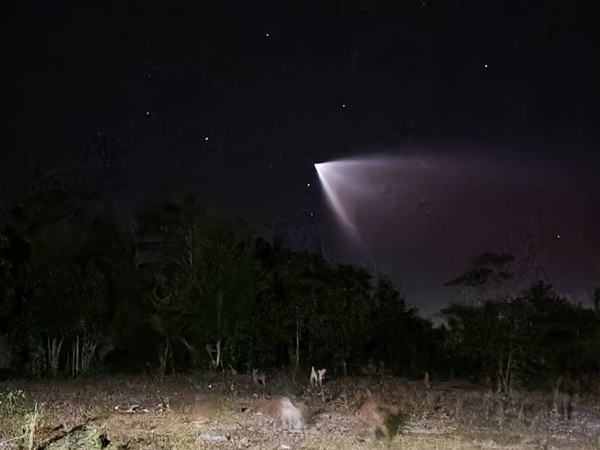
Photo courtesy of Rachiel Batutay Bolaljog
Residents across parts of the Philippines witnessed unusual glowing lights in the night sky on May 12, 2026, at around 8:10 PM PhST, which experts say were likely caused by the launch of China’s Long March 6A rocket.
The rocket, officially known as Long March 6A (Chang Zheng 6A), was launched from the Taiyuan Satellite Launch Center at approximately 7:58 PM PhST.
The luminous formation observed over the Philippines is commonly referred to as a “space jellyfish,” a phenomenon that occurs when rocket exhaust plumes at high altitudes are illuminated by sunlight while the ground below is already dark.
As the rocket travels through the upper atmosphere, expanding exhaust gases scatter sunlight, producing a glowing jellyfish-like appearance visible across large areas during twilight conditions.
The event sparked curiosity and social media discussions among Filipinos who reported seeing bright streaks and glowing cloud formations in the sky.
Authorities noted that unlike some recent Chinese rocket launches from coastal spaceports, no projected debris drop zones from this mission were expected to affect Philippine territory or waters.
The sighting highlights the increasing visibility of modern space launches across the Asia-Pacific region as global satellite deployment and aerospace activities continue to grow.