







Southeast Asia is positioning itself as a major artificial intelligence (AI) infrastructure hub as telecommunications providers, data centers, and emerging neoscalers invest in high-capacity connectivity to support the next wave of AI adoption.
Insights from a Ciena virtual roundtable featuring Francisco Sant’Anna, Senior Advisor for Marketing Intelligence at Ciena; Alex Wong, Regional Managing Director for ASEAN, Hong Kong, and Taiwan at Ciena; and Baharul Nizam Said Daliman, Vice President for International Sales at TM Global, highlighted how AI growth is accelerating demand for advanced optical networks, distributed computing infrastructure, and regional data center connectivity.
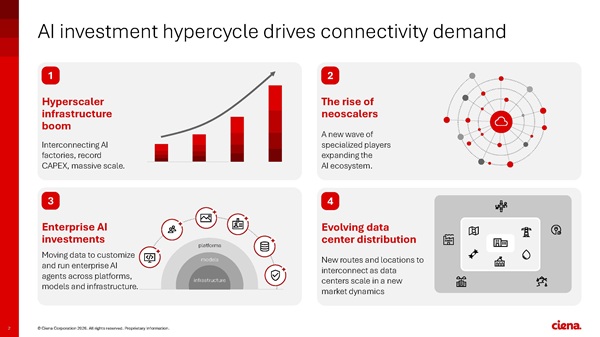
According to Ciena’s Wave Services Report, global revenue for high-capacity optical connectivity services is projected to grow at an average annual rate of 18%, while Southeast Asia is expected to outpace the global market with a 22% compound annual growth rate (CAGR). This expansion is being fueled by increasing demand for 100G, 200G, and 400G+ connectivity services required to support intensive AI workloads.
Neoscalers accelerate AI infrastructure growth
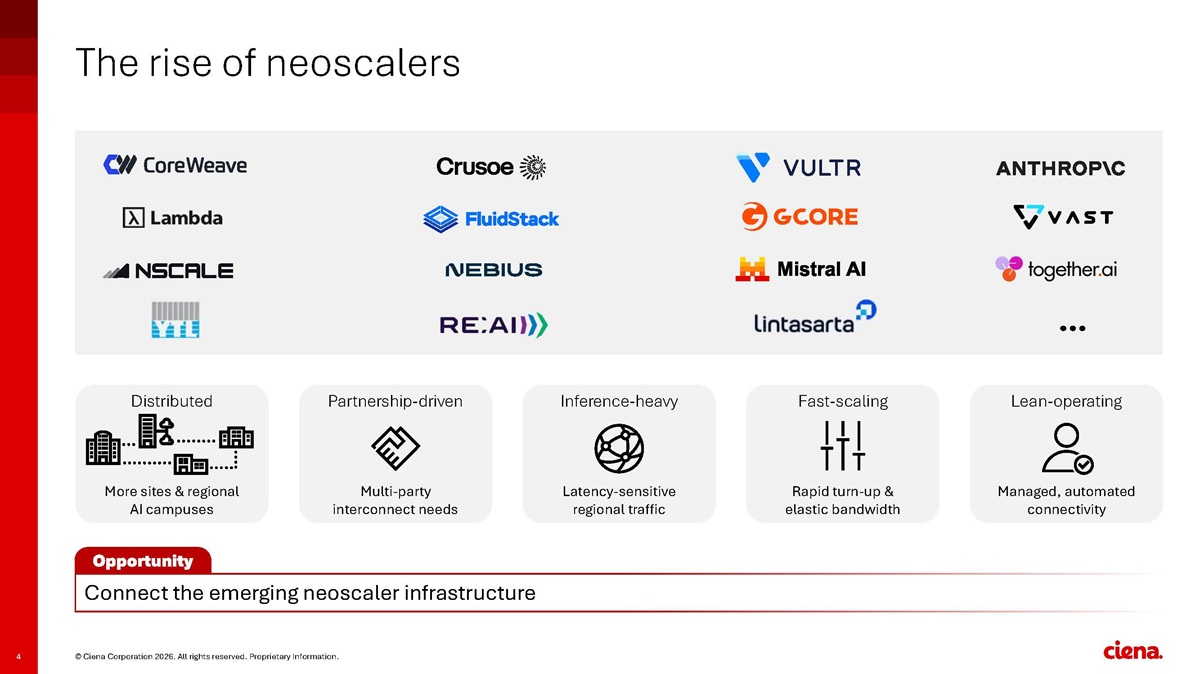
A key trend shaping the AI infrastructure landscape is the rise of neoscalers—specialized providers offering GPU-as-a-service and AI infrastructure capabilities alongside traditional hyperscalers.
Unlike hyperscalers that operate large proprietary infrastructure platforms, neoscalers rely on highly automated, flexible, and scalable network environments to rapidly deploy AI computing resources. As AI applications evolve from model training toward real-time inference, these providers are becoming increasingly important in delivering low-latency AI services closer to end users.
Global investments in AI inference infrastructure are expected to surpass AI training investments in 2026, creating greater demand for geographically distributed computing facilities across Southeast Asia.
AI reshapes regional data center corridors
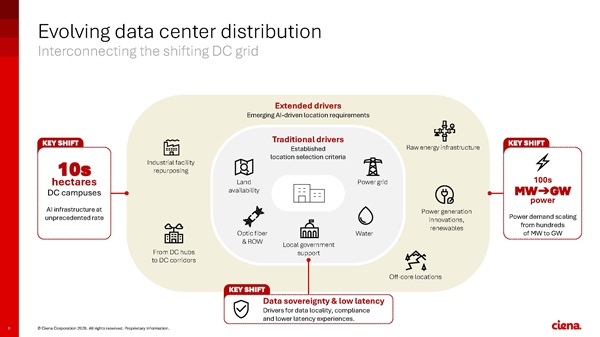
The rapid expansion of AI workloads is also transforming Southeast Asia’s data center ecosystem. Capacity constraints in established markets, including land and power limitations in Singapore, are encouraging investments in emerging locations such as Johor, Malaysia, and Indonesia.
TM Global is expanding its hyperconnected data centers in Klang Valley and Johor to support AI training and inference workloads. Meanwhile, the Philippines is expected to strengthen its role as a subsea connectivity gateway, linking international traffic with regional AI infrastructure corridors.
CSPs build AI-ready networks
Communication service providers (CSPs) are moving beyond traditional fiber connectivity services by developing automation-driven, AI-ready infrastructure designed for large-scale workloads.
Key technologies supporting this transition include:
- Coherent 800G optical technology for transporting massive AI datasets more efficiently
- Advanced network automation for faster deployment and dynamic capacity management
- AI-powered network operations for predictive maintenance and optimized performance
- Low-latency network architectures designed for GPU-based parallel processing
CSPs are also increasing physical network capacity. TM Global noted that cable deployments are evolving from 96 fiber cores to 384 fiber cores to meet rising bandwidth requirements from AI applications.
“AI infrastructure players build for massive parallel processing and constant data movement. This requires a different mindset—one that is much more capacity-led, performance-led, and time-to-market driven,” said Alex Wong of Ciena.
Data sovereignty becomes critical for AI ecosystems
Beyond connectivity and computing capacity, data sovereignty is becoming a strategic consideration for AI infrastructure investments. Organizations and governments are increasingly focused on where data is processed, stored, and controlled.
Francisco Sant’Anna of Ciena said regional providers have an opportunity to become “Technology National Champions” by enabling sovereign AI ecosystems that maintain local data control while allowing access to global innovation.
As Southeast Asia transitions from a connectivity market into a global AI infrastructure hub, industry leaders believe the region’s competitiveness will depend on building networks capable of supporting large-scale AI workloads, distributed computing, and secure digital ecosystems.
“Southeast Asia is no longer just a transit node—it is rapidly becoming a major global AI hub,” said Baharul Nizam Said Daliman of TM Global. “We aren’t just building networks; we are laying the digital foundation that allows AI to scale and thrive.”