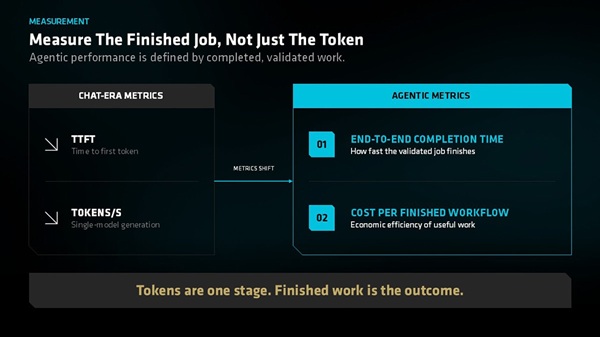







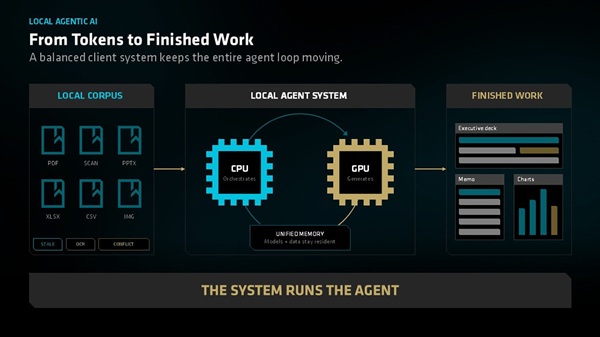
Chat delivered a single response; an agent delivers finished, validated work—a system outcome, not just a single GPU pass.
AMD has released benchmark results showing that its Ryzen AI Max+ 395 processor, powered by the Ryzen AI Halo architecture, delivers faster end-to-end performance and lower costs for on-device AI agents than NVIDIA’s DGX Spark system.
The findings highlight a growing shift in AI computing as organizations increasingly deploy agentic AI workloads that run locally rather than relying entirely on cloud-based inference. While traditional AI performance metrics focused on token generation speed, AMD argues that agentic workloads should be measured by workflow completion time and cost per completed task.
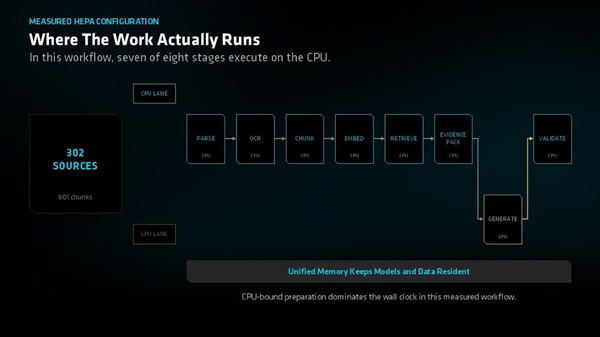
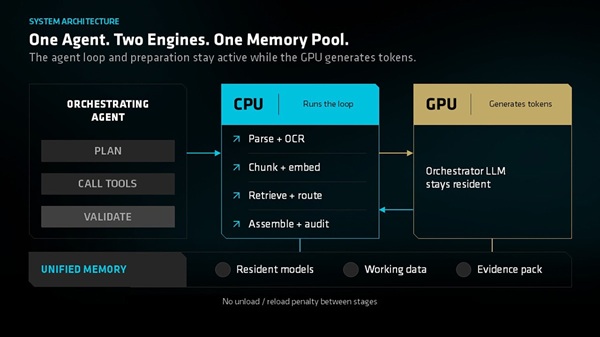
To evaluate real-world performance, AMD developed the Hermes Executive Presentation Agent (HEPA) benchmark, which simulates an enterprise knowledge worker creating an executive presentation, supporting memo, charts, and cited references from a large collection of local documents. The workflow includes OCR, document parsing, embedding generation, retrieval, validation, and text generation.
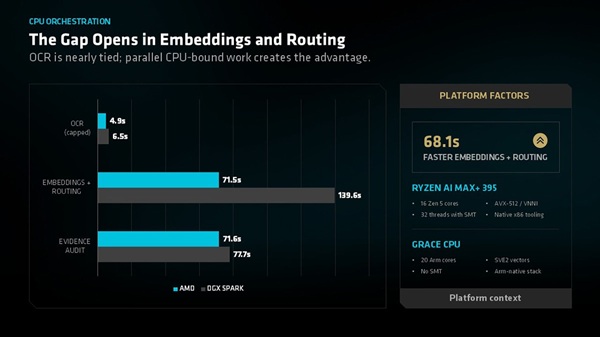
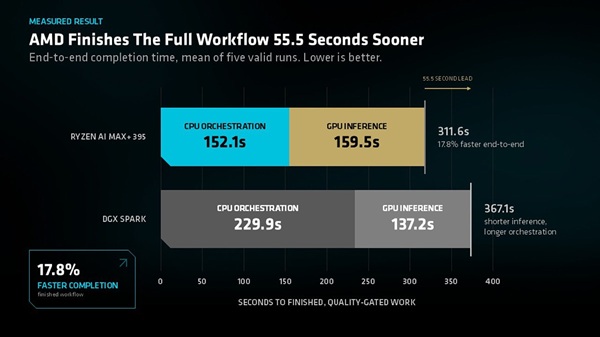
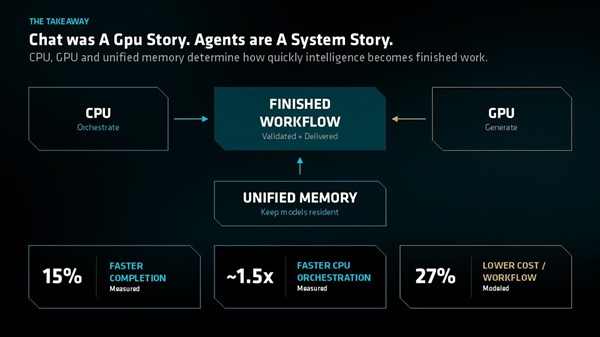
Using identical datasets, models, and configurations on both systems, AMD reported that the Ryzen AI Halo platform completed CPU orchestration tasks 34% faster than NVIDIA DGX Spark, reducing preparation time from 229.9 seconds to 152.1 seconds. The company said embedding generation and routing workloads, which run primarily on the CPU, were nearly twice as fast on the AMD system.
Overall, AMD claimed the Ryzen AI Halo platform completed the full AI agent workflow 15% faster, finishing in 311.6 seconds compared with 367.1 seconds for DGX Spark. AMD also reported a 27% lower cost per completed workflow based on a three-year hardware amortization model.
According to AMD, the advantage stems from the processor’s 16 Zen 5 cores and 32 threads, along with AVX-512 and VNNI acceleration, which improve performance for CPU-intensive tasks such as OCR, embeddings, document processing, and orchestration. While NVIDIA’s DGX Spark showed stronger inference performance, AMD noted that inference represented only one stage of the overall workflow.
The company argues that as AI agents evolve into systems that combine orchestration, retrieval, reasoning, OCR, speech, and multiple AI models, overall system balance—including CPU, GPU, and unified memory—will become more important than raw GPU token-generation speeds alone.
AMD said the results reinforce the growing importance of on-device AI, which offers benefits such as lower operating costs, improved privacy, offline operation, and reduced latency compared with cloud-based AI services.