







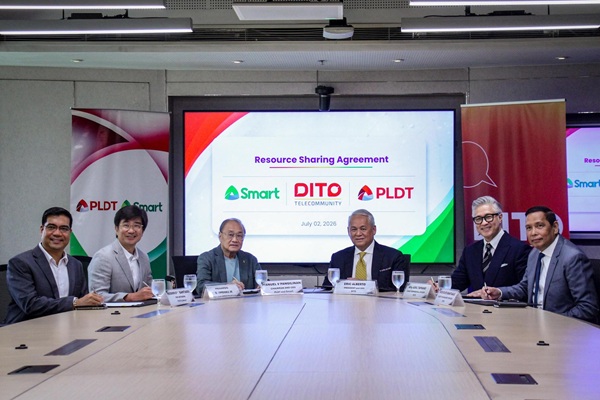
(L-R) Roderick S. Santiago, PLDT First Vice President for Network; Menardo G. Jimenez, PLDT Chief Operating Officer; Manuel V. Pangilinan, PLDT Chairman and CEO; Eric R. Alberto, DITO Telecommunity President and CEO; Adel Tamano, DITO Chief Commercial Officer; and Rodolfo Santiago, DITO Chief Technology Officer, during the signing of the Memorandum of Understanding (MOU) on strategic telecommunications infrastructure sharing to expand network coverage and enhance connectivity across the Philippines.
PLDT Inc., Smart Communications, Inc., and DITO Telecommunity have signed a Memorandum of Understanding (MOU) to pursue strategic infrastructure-sharing initiatives aimed at expanding network coverage and improving connectivity across the Philippines.
The agreement establishes a reciprocal resource-sharing framework covering three key areas: macro tower site access, in-building solution (IBS) colocation, and submarine cable capacity through Indefeasible Right of Use (IRU) arrangements. The collaboration will be implemented without any monetary exchange between the parties.
By sharing existing telecommunications infrastructure instead of building duplicate facilities, the companies aim to accelerate network expansion, improve service reliability, and optimize investments while extending connectivity to more Filipinos.
“Connecting the country is a responsibility that we all share as Philippine telcos,” said PLDT Chairman and CEO Manuel V. Pangilinan. “This agreement reflects that, even as we compete in the marketplace, we can collaborate where it matters most—accelerating digital inclusion and helping connect every Filipino.”
DITO Telecommunity President and CEO Eric Alberto said the partnership will enable both companies to deliver better services and could pave the way for broader collaboration that benefits customers and the telecommunications industry.
The initiative underscores a growing trend of infrastructure sharing among telecom operators to build a more resilient, cost-efficient, and future-ready digital ecosystem while supporting the country’s digital transformation goals.