







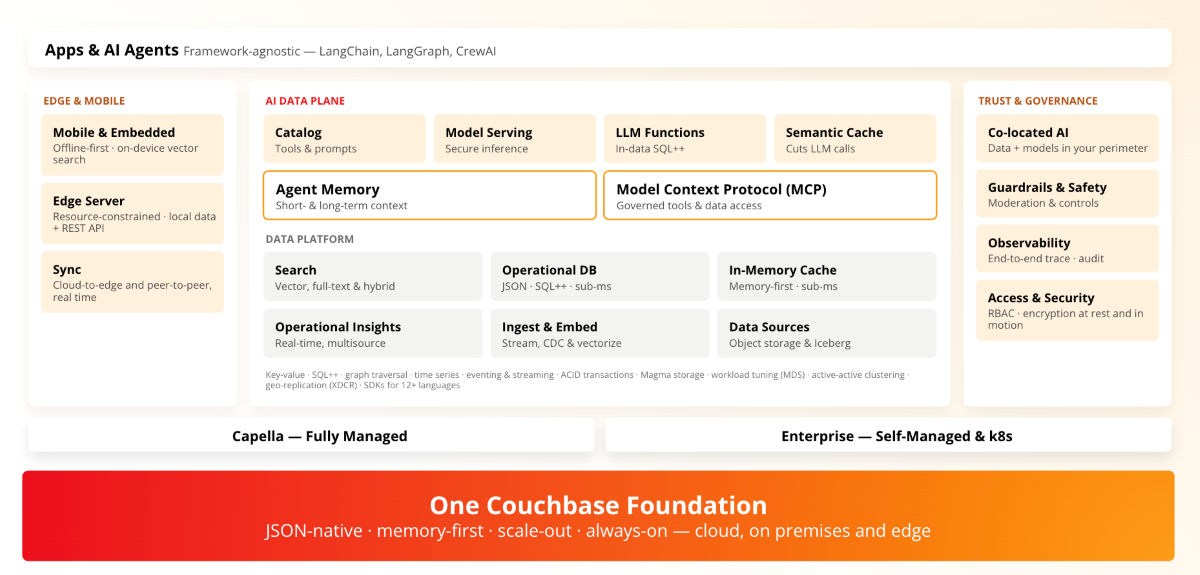
Couchbase has expanded its AI Data Plane with new capabilities designed to simplify enterprise AI agent deployments, reduce infrastructure complexity, and lower the cost of running production artificial intelligence workloads.
The enhancements include native Amazon Bedrock integration with semantic caching, managed Agent Memory, a managed Model Context Protocol (MCP) server on Amazon Web Services (AWS), and vector search within Couchbase Operational Insights. All the announced capabilities are generally available.
The expanded platform aims to help enterprises manage operational data, AI context, search, and analytics through a single governed data layer, reducing the need to maintain separate systems for production AI applications.
Amazon Bedrock integration and AI cost optimization
Couchbase’s expanded Model Service integrates with Amazon Bedrock, providing access to foundation models through a serverless, pay-per-token approach, with vectorization over private networking. Semantic caching allows applications to reuse results from semantically similar queries rather than repeatedly invoking large language models (LLMs).
According to Couchbase, semantic caching has demonstrated the potential to reduce LLM calls by 40% to 60%, helping lower inference costs and latency.
Managed memory and MCP server for AI agents
The new managed Agent Memory service enables AI agents to retain user profiles, conversation histories, and vectorized information across sessions. This allows agents to maintain context instead of starting from scratch with every interaction.
Meanwhile, the managed MCP server provides a governed, open-standard connection between AI agents and Couchbase data without requiring customers to deploy and maintain the server themselves. Both services support frameworks including LangGraph, CrewAI, and LlamaIndex.
Vector search meets operational analytics
Couchbase Operational Insights now combines vector search with structured analytical queries against continuously updated operational data. This allows organizations to analyze semantic patterns and structured information together without relying on separate systems or extract, transform, and load (ETL) pipelines.
For example, businesses can analyze revenue by region while filtering results based on customer sentiment, including patterns associated with frustrated customers. The platform can also write query results back into operational data, allowing applications and agents to act on insights more quickly.
Couchbase said customers that consolidate fragmented data services onto its platform have reported total cost of ownership reductions exceeding 50% in more than half of deployments. The company also reported that its Agent Memory can reduce token usage by 33% to 45%, while vector-based context retrieval can produce prompts that are 70% smaller than full-context alternatives.
The expanded AI Data Plane builds on Couchbase’s distributed architecture, which supports operational workloads across public clouds, private data centers, and edge environments, including offline-capable applications through Couchbase Mobile.
All announced capabilities are generally available. Pricing and packaging information is available at Couchbase’s pricing page.