








Global 5G mobile subscriptions exceeded 3.1 billion in the first quarter of 2026, with the total expected to more than double to 6.4 billion by 2031, according to the latest Ericsson Mobility Report.
The report highlights how the rapid expansion of 5G Standalone (SA) networks and network slicing is transforming mobile connectivity to support emerging AI-powered applications. Commercial 5G SA network slicing offerings increased from 65 to 84 globally, reflecting broader adoption of guaranteed quality-of-service services for enterprises and consumers.


Ericsson said AI is reshaping network traffic patterns, with uplink mobile data traffic now growing faster than downlink for most service providers. The shift is driven by cloud storage, content creation, collaboration apps, and the expected rise of distributed AI systems running on connected devices, vehicles, and smart cities.
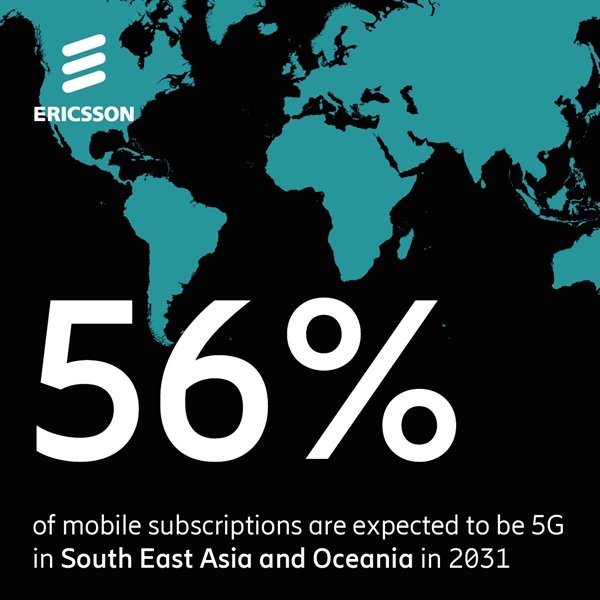
In Southeast Asia and Oceania, 5G subscriptions are projected to grow from 160 million in 2025 to 670 million by 2031, with the Philippines recording one of the region’s fastest-growing 5G adoption rates.
The report also points to growing momentum for 5G Fixed Wireless Access (FWA), particularly in the Philippines, where the technology is helping expand broadband connectivity in fiber-limited areas while creating new revenue opportunities for operators.
By the end of 2025, 5G networks carried 48% of global mobile data traffic, a figure expected to reach 85% by 2031, underscoring the technology’s increasing role as the foundation for AI-driven digital services and next-generation mobile experiences.