




A microgravity experiment designed by students from Rizal Technological University (RTU) was successfully carried out aboard the International Space Station (ISS) as part of the 2025 Asian Try Zero-G (ATZG 2025) competition organized by the Japan Aerospace Exploration Agency (JAXA).
The experiment, titled “Double Gyroscope,” was created by third-year astronomy students majoring in astrophysics: Christopher Tumamac, Ryan Andrew Doña, and Rose Ann Cezar.
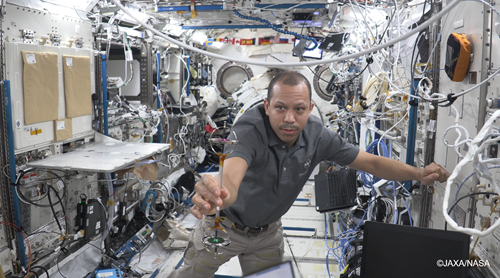
The experiment was performed inside the Kibo module of the ISS on March 24, 2026 by Christopher Williams, an astronaut from the National Aeronautics and Space Administration (NASA). The live experiment was streamed to finalists gathered at the JAXA Tsukuba Space Center in Japan.
The Double Gyroscope experiment explored spacecraft orientation principles using two spinning gyroscopes attached to a stick. The Filipino students hypothesized that opposite spinning directions could cancel motion and create stability in a microgravity environment, while small variations could slowly alter orientation over time.
Astronaut Williams repeatedly tested the gyroscopes in zero gravity to observe their movement and stability behavior. According to the team, the results aligned with their original hypotheses.
The Philippine entry was among 11 finalists selected from across the Asia-Pacific region, including participants from Australia, Bangladesh, Japan, Malaysia, Singapore, Taiwan, Thailand, and the UAE.
The Philippines joined the competition through the Philippine Space Agency (PhilSA), which organizes local participation as part of its science education and space outreach programs. Since 2022, several Filipino student experiments have been selected and conducted aboard the ISS through the ATZG initiative.
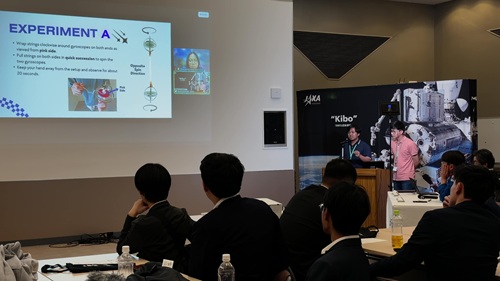
Facing the photo: (L) Christopher Tumamac and (R) Ryan Andrew Doña present their “Double Gyroscope” experiment proposal at the Tsukuba Space Center in Japan as part of the 2025 Asian Try Zero-G competition.
Team members Doña and Tumamac also presented their proposal at the JAXA Tsukuba Space Center before the live execution. During the awarding ceremony, JAXA Kibo Utilization Center Director Masaki Shirakawa and JAXA astronaut Norishige Kannai recognized the finalists with certificates of recognition.
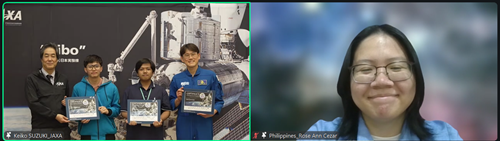
JAXA Kibo Utilization Center Director Dr. Masaki Shirakawa (left-most) and JAXA astronaut Norishige Kannai (second-to-the-right) present Team Double Gyroscope with their certificates of recognition as finalists in the 2025 Asian Try Zero-G (ATZG2025) competition. Photo courtesy of JAXA/NASA.
The successful mission highlights the growing participation of Filipino students in global space science programs and demonstrates increasing local interest in astrophysics, aerospace engineering, and microgravity research.
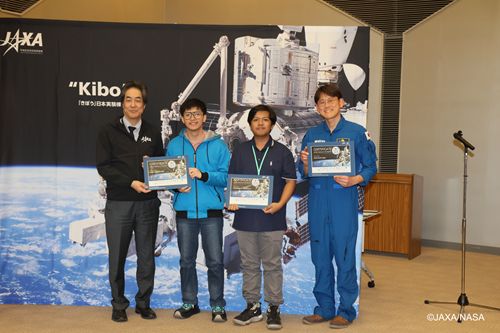
JAXA Kibo Utilization Center Director Dr. Masaki Shirakawa (left-most) and JAXA astronaut Norishige Kannai (right-most) present Ryan Andrew Doña and Christopher Tumamac of the Philippines’ Team Double Gyroscope with their certificates as finalists in the 2025 Asian Try Zero-G (ATZG2025) competition. (Not in photo: finalist Rose Ann Cezar.) Photo courtesy of JAXA/NASA.
Watch the experiment here: Double Gyroscope Experiment Video