




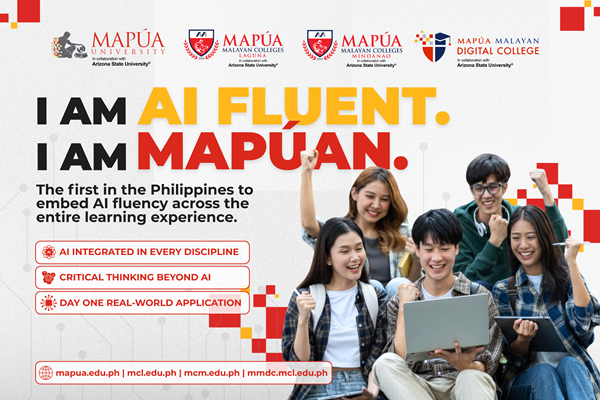
The Mapúa Education Group, in collaboration with Arizona State University (ASU), has unveiled the Philippines’ first comprehensive institutional AI Fluency Strategy, marking a significant shift in how higher education prepares students for an AI-driven future.
The initiative moves beyond traditional AI literacy programs by embedding artificial intelligence across the entire academic experience. Rather than simply teaching students how AI works, the strategy aims to develop graduates who can effectively collaborate with AI systems, critically evaluate AI-generated outputs, and apply AI responsibly within their respective disciplines.
According to Dodjie S. Maestrecampo, AI fluency extends beyond understanding AI tools and focuses on the ability to apply them meaningfully, detect errors and bias, and combine human judgment with technology to solve real-world problems.
Set for full implementation in Academic Year 2026–2027, the strategy introduces a four-layer curriculum framework covering foundational AI concepts, discipline-specific applications, AI-enhanced learning, and advanced pathways such as AI Engineering and Data Science. The program will be supported by the institution’s new Mapúa AI Teaching Commons, a faculty development platform designed to help educators integrate AI into teaching and assessment.
A key component of the initiative is the adoption of the HyFlip learning model, which shifts basic instruction to AI-supported asynchronous learning while dedicating classroom time to collaboration, mentoring, and critical thinking exercises. The university is also implementing a process-based assessment system that distinguishes between AI-prohibited, AI-assisted, and AI-integrated coursework to promote academic integrity and responsible AI use.
The strategy builds on Mapúa’s earlier rollout of ChatGPT Edu, providing students, faculty, and staff access to advanced AI tools designed for academic and professional applications.
Mapúa officials believe the initiative will strengthen graduate employability by equipping students with the skills needed to work alongside intelligent systems while maintaining accountability for ethics, accuracy, fairness, and societal impact.
The move positions the Mapúa Education Group—which includes Mapúa University, Mapúa Malayan Colleges Laguna, Mapúa Malayan Colleges Mindanao, and Mapúa Malayan Digital College—at the forefront of AI-driven education in the Philippines as institutions worldwide adapt to the growing influence of artificial intelligence across industries.