







The Philippine Space Agency (PhilSA) and the Japan Aerospace Exploration Agency (JAXA) have strengthened their collaboration in space science and technology through the signing of a Joint Declaration of Interest in Space Cooperation on May 27, 2026.
Signed during President Ferdinand Marcos Jr.’s state visit to Japan, the agreement outlines potential cooperation in satellite missions and data applications, space exploration and human spaceflight, as well as space sustainability. The partnership aims to advance the use of space technologies for disaster resilience, environmental monitoring, scientific research, and digital transformation.
The declaration coincides with the 10th anniversary of the launch of the Philippines’ first microsatellite, Diwata-1, which was deployed from the Japanese Experiment Module aboard the International Space Station (ISS). It also builds on decades of collaboration between the two countries, including the co-hosting of the 31st Asia-Pacific Regional Space Agency Forum (APRSAF-31) in Cebu in 2025.
A major area of cooperation is disaster management through Sentinel Asia, a regional initiative led by JAXA and the Asian Disaster Reduction Center. Between 2024 and 2025, Philippine agencies submitted 20 emergency satellite observation requests covering floods, landslides, storms, earthquakes, volcanic activity, and oil spills.
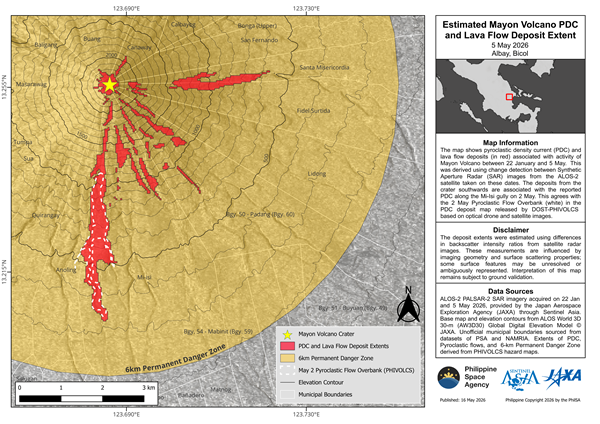
One recent application involved the use of JAXA’s ALOS-2 Synthetic Aperture Radar satellite to map volcanic deposits from Mayon Volcano following a pyroclastic density current event in May 2026. The satellite’s radar technology enabled monitoring even in cloud-covered and inaccessible areas.
The partnership also supports science education and workforce development through JAXA’s Kibo Asian Beneficial Collaboration program, which allows Filipino students and researchers to participate in experiments aboard the ISS. Philippine teams have also participated in initiatives such as Asian Try Zero-G, Asian Herb in Space, and the Kibo Robot Programming Challenge.
The expanded cooperation reflects the growing role of space technologies in addressing national priorities, including disaster preparedness, environmental protection, food security, and innovation-driven economic development.