







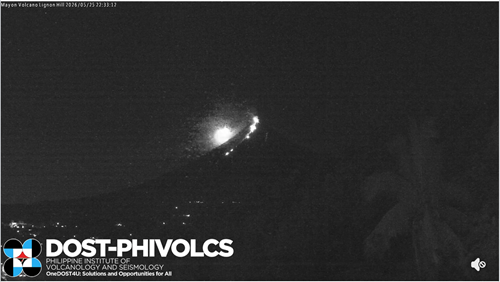
Photo credit: Department of Science and Technology–Philippine Institute of Volcanology and Seismology
A bright streak of light recorded above Mayon Volcano on May 25, 2026, was confirmed to be a meteor entering Earth’s atmosphere, according to the Philippine Institute of Volcanology and Seismology.
The event was captured at 10:33 PM by PHIVOLCS’ Ligñon Hill monitoring camera, showcasing a rare and visually striking moment with the iconic volcano in the foreground. Scientists explained that meteors, commonly known as “shooting stars,” regularly enter Earth’s atmosphere but usually burn up completely before reaching the ground.
As space rocks travel at extremely high speeds, atmospheric friction generates intense heat that vaporizes the objects at altitudes ranging from 60 to 100 kilometers above sea level. The process also ionizes surrounding air molecules, creating the bright flash visible from Earth. Any fragments that survive atmospheric entry and land on the surface are classified as meteorites.
PHIVOLCS noted that tracking meteor trajectories remains a complex scientific challenge. Around the world, researchers rely on radar systems, optical camera networks, and computational modeling technologies to monitor and analyze meteor activity in real time.
The captured footage highlights how modern optical monitoring systems used for volcanic surveillance can also document unexpected astronomical events.