






AMD is expanding the capabilities of local enterprise AI with its new Ryzen AI Max 400 and Ryzen AI Max PRO 400 Series processors, designed to support agentic AI workloads that can run directly on business systems instead of relying entirely on cloud infrastructure.
Unlike conventional generative AI chatbots, AI agents can perform multi-step tasks, interact with applications and tools, retrieve information, and execute workflows with greater autonomy. This creates new demands for computing power, memory, data access, and cost management.
AMD’s new processors are built around this emerging workload, offering up to 16 Zen 5 CPU cores, a 55 TOPS NPU, 40 GPU compute units, and up to 192GB of unified memory. Up to 160GB can be dedicated to GPU workloads.
The increased memory capacity is particularly relevant for agentic AI, where multiple models, large context windows, enterprise data, and software tools may need to operate simultaneously.
Local AI for enterprise development
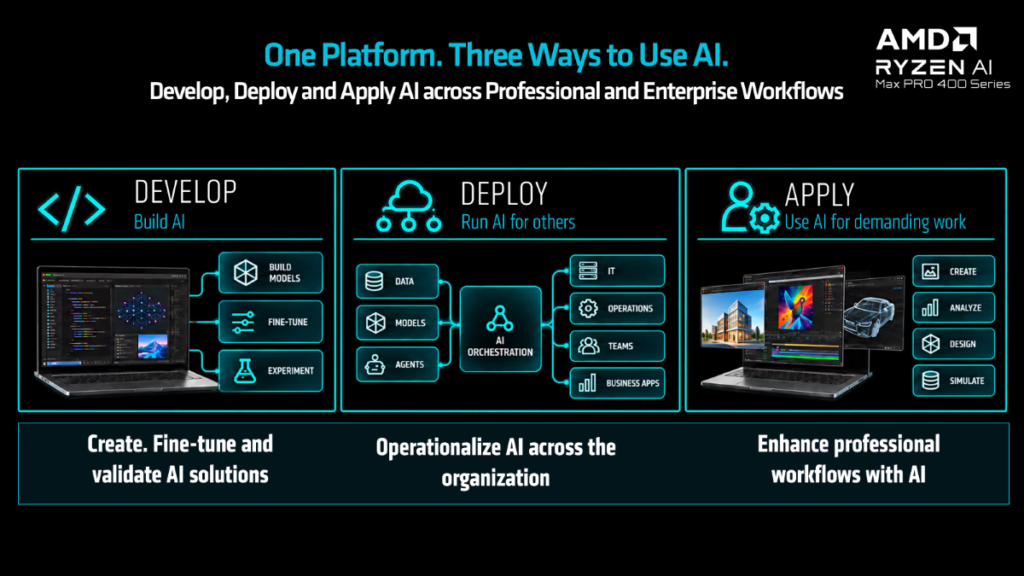
AMD says Ryzen AI Max PRO 400 Series systems can support the development and deployment of enterprise AI agents locally. The platform supports Windows and Linux environments and works with AI development tools and frameworks including PyTorch, vLLM, llama.cpp, Ollama, ComfyUI, and LM Studio.
The company also highlights the processor’s ability to run models with more than 300 billion parameters at 4-bit quantization without requiring cloud offload, under AMD’s specified conditions.
AMD is positioning local AI as a complement to cloud computing rather than a replacement. Businesses can keep suitable workloads and sensitive data on local systems while sending more demanding tasks to cloud-based models.
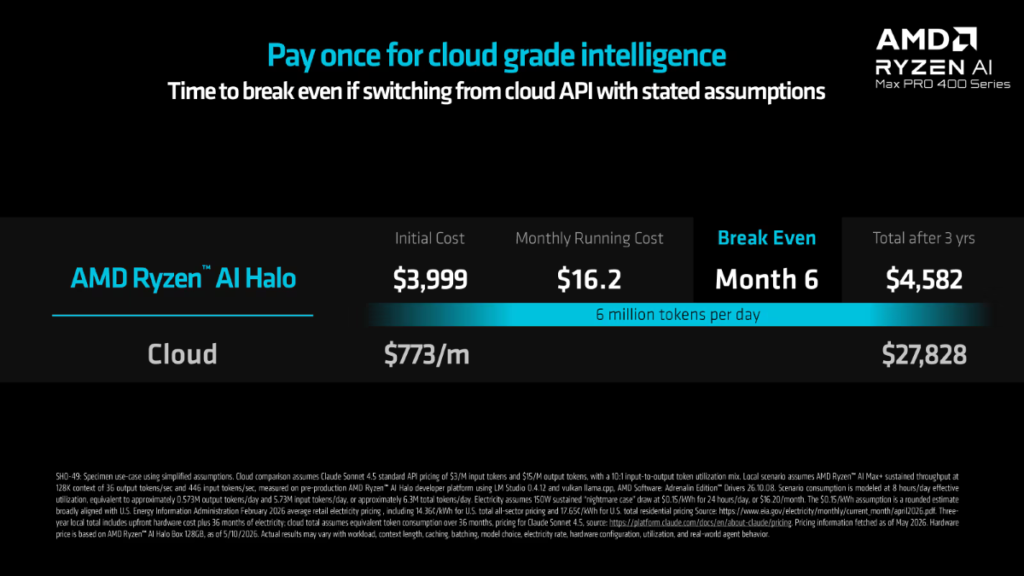
This hybrid approach could also help organizations manage the rising cost of agentic AI, as autonomous agents can consume substantially more tokens than conventional chatbot interactions by repeatedly reasoning, retrieving information, and invoking models.
AMD’s Tokenomics Calculator allows organizations to compare potential cloud-only, local-only, and hybrid AI deployment costs based on factors such as users, token consumption, hardware requirements, and cloud-model pricing.
With agentic AI moving toward enterprise deployment, AMD is positioning its latest Ryzen AI platforms as another option for companies seeking greater local computing capacity, data control, and flexibility in deciding where AI workloads are processed.